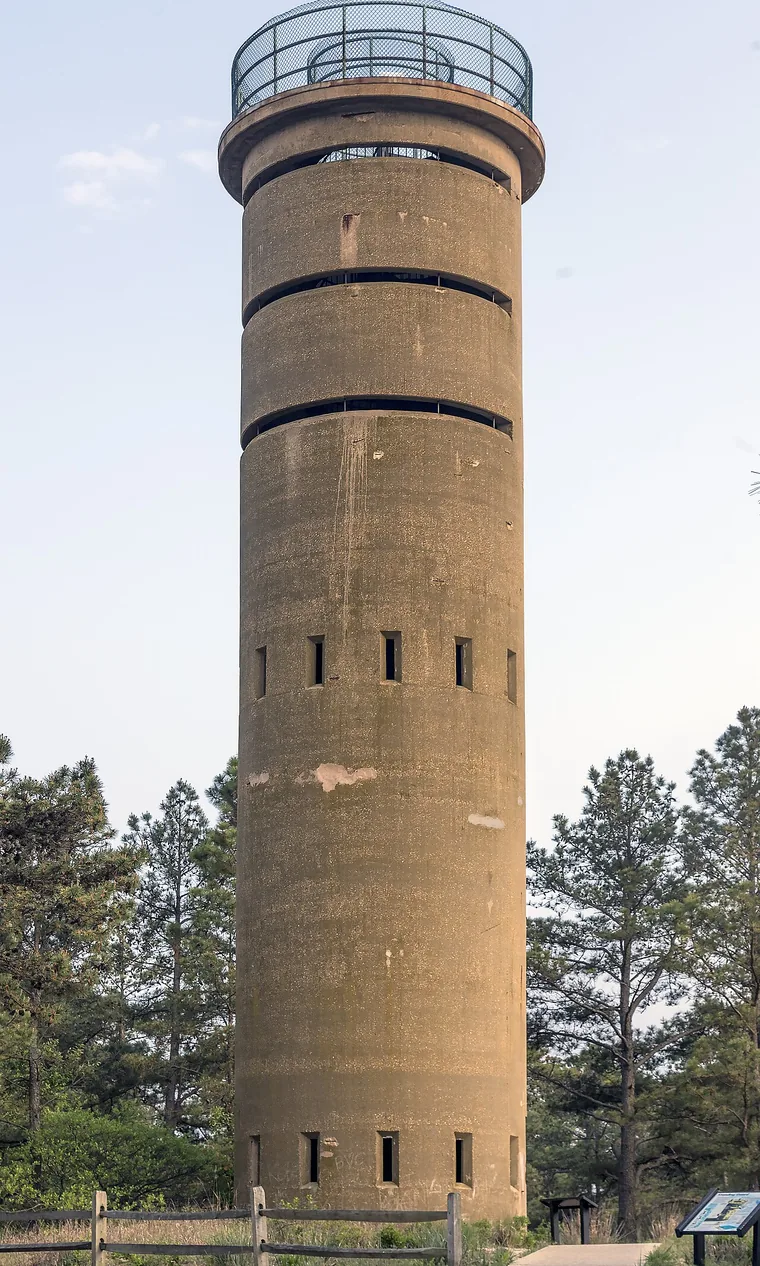
Plain concrete cylinders standing in the dunes, with a slit near the top and a door facing away from the sea. Eleven concrete towers along the Delaware shore and four more across the bay in New Jersey, plus five steel ones further up the Delaware side — twenty in all. The concrete shell of one went up in two and a half to three days, and each was built to last twenty years.
A wartime tower rising over the pines at Cape HenlopenOne of the park's concrete towers, seen across the treetops.Photograph by Ben Felps, via Wikimedia Commons. Cropped and resized; reused under CC BY-SA 3.0.
They have been standing for more than eighty.
What they were actually for
This is the part that surprises people, and it is worth getting right, because the towers are not what they look like.
They were not gun positions. There was never a gun in one. They were the aiming system.
Out at sea, everything is the same distance away.
Look at a ship on open water and you cannot tell whether it is four miles off or fourteen. And if you cannot tell, you cannot shoot at it — because a shell has to be thrown in an arc and land where the ship will be by the time it gets there.
How they solved it
With two towers and some school geometry.
- Two towers stand miles apart along the coast, and the exact distance between them is surveyed and known.
- Each has a telescope on a marked circle that reads off the precise compass direction it is pointing.
- A spotter in each tower keeps the crosshairs on the same ship.
- A bell rings — automatically, every twenty or thirty seconds. At the instant it rings, a second soldier reads the number off the dial and telephones it down.
- In the plotting room, deep inside the bunker at Fort Miles, both directions are drawn as lines on a board. Where the two lines cross is the ship.
Do it again thirty seconds later and you have a second position. Now you know the ship's course and speed, and you can work out where it will be when the shell lands.
That is triangulation, and it is why the towers are spread out along the coast rather than clustered at the fort. The distance between them is the instrument.
The towers are half of this story
These towers were built to see what the guns could not. Cape Henlopen: The Surrender is a history game you play on the Cape May–Lewes Ferry — the four years men watched this bay from towers like this one, and how the watch ended. One pass covers up to six devices and runs about seventy minutes.
See what it is →How they were built
| Walls | About a foot of poured reinforced concrete, sometimes mixed with beach sand |
|---|---|
| Diameter | Roughly 17 feet |
| Height | Ranging from about 40 feet to about 90 feet |
| Build time | Two and a half to three days for the shell, using a sliding form that rose as the concrete set |
| Design life | Ten years |
| Actual life so far | More than eighty |
The horizontal slits near the top are the lookout windows. The single door faces inland, away from the beach — the whole structure was meant to be as hard as possible to see or hit from the sea.
On the tower count: you will see different numbers quoted, from eleven up to twenty. It depends what is being counted — concrete towers in Delaware only, or the whole two-state system including New Jersey and the steel towers along the bay. The safe version is about a dozen along the Delaware shore and four more in New Jersey.
The one you can climb
Tower 7, in the Fort Miles historic area at Cape Henlopen State Park. It is the only Delaware tower that has been renovated and opened to the public — fitted with a modern steel staircase, with observation levels and a view from the top.
From up there you get what the spotters got: the Atlantic on one side, the mouth of Delaware Bay on the other, and the Cape May–Lewes ferry crossing the middle of it.
It is a real climb — a lot of stairs, no elevator. And access varies with weather, staffing and maintenance, so check with the park before you build a day around it.
The other Delaware towers are visible but sealed. Their original interior stairs have rusted out or been cut away for safety, which is exactly why the one that was rebuilt is the one you can go up.
And one on the other side
Across the bay at Cape May Point, New Jersey, there is a second climbable tower — the last freestanding one left in that state, poured in two and a half days in June 1942 and now open to visitors for an admission fee. It was part of the same system: one of the pair of eyes that fixed a ship's position between them.
One tower per cape. Cape Henlopen on the Delaware side, Cape May Point on the New Jersey side, with the mouth of the bay between them. If you take the ferry you can climb both ends of the same instrument in a single day, and cross the water they were built to watch on the way over.
Related
Fort Miles →
The guns the towers were aiming, and the bunker where the lines were drawn on the board.
The ferry →
Eighty-five minutes across the water they were watching.
The fishing pier →
Where the only enemy vessel that ever came in tied up, in 1945.
The four on the New Jersey side
Eleven of these towers went up along the Delaware coast. Four more went up in New Jersey — at Cape May Point, Cape May City, Wildwood Crest and North Wildwood — and they were not a separate system. Towers on the New Jersey shore fed firing data to Delaware guns and back again, across ten miles of open water.
Only one of the four is still standing free: Fire Control Tower No. 23 at Cape May Point, restored and open to climb. Two were demolished. The fourth was swallowed whole by a hotel built around it, and its top is still visible above the roofline.