There is a concrete bunker stranded on the beach at Cape May Point, and a seventy-one-foot concrete cylinder a short way inland that you can climb to the top of. They worked as a pair, and the other half of the system was across the water at Cape Henlopen.
Battery 223 on the beachBuilt more than nine hundred feet inland in 1942, under earth and planted with grass. This is where the shoreline has got to.Photograph by King of Hearts, September 2020, via Wikimedia Commons. Cropped and resized; reused under CC BY-SA 4.0.
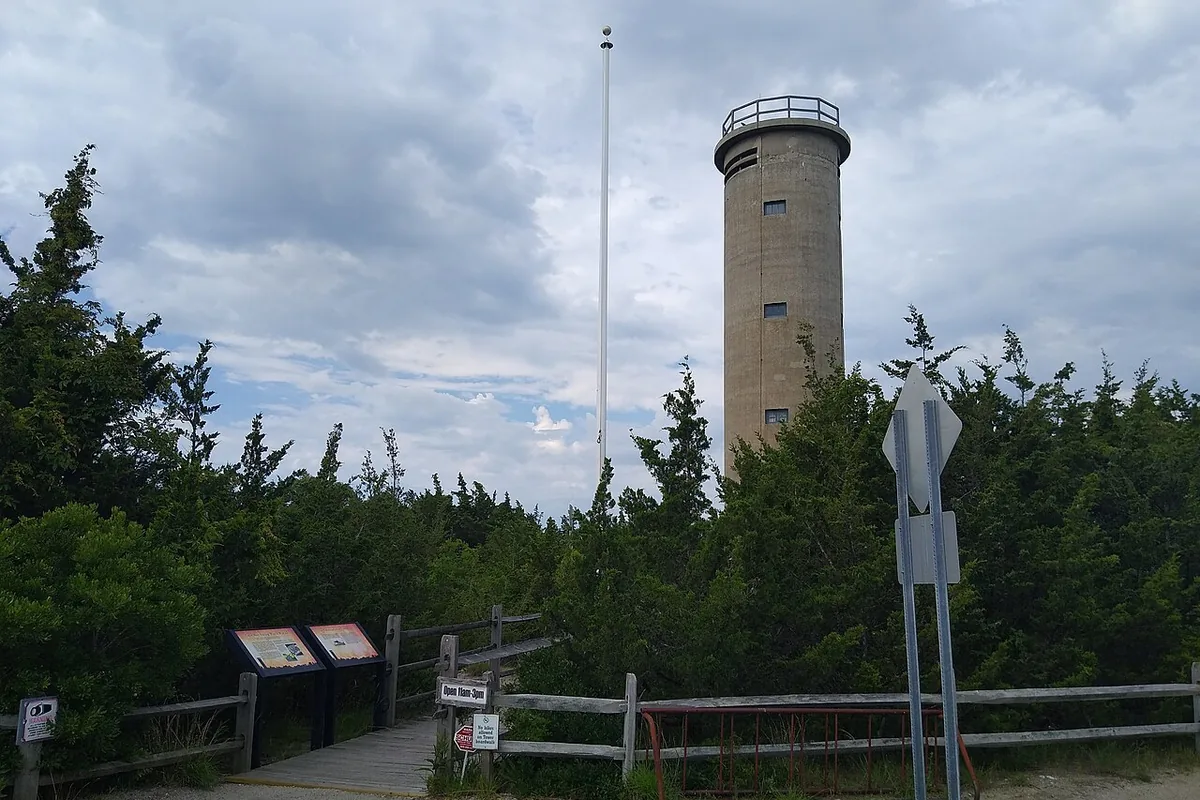
Fire Control Tower No. 23
It was poured on site between June and September 1942, inside a sliding tube-shaped form — the concrete itself took roughly two and a half days.
| Height | 71 feet |
|---|---|
| Diameter | 17 feet |
| Walls and roof | 1 foot thick, with an overhanging roof 20 feet across |
| Levels | Six, separated by 6-inch concrete floors |
| Top level | Two slit windows, 12 inches high, running three-quarters of the way around |
Levels one through five each had four openings roughly at the compass points, for azimuth instruments. Level five was the day room — wooden floor, coal stove — because men stood in this thing for years.
Battery 223 is in the game too
The New Jersey side of the watch is a chapter of Cape Henlopen: The Surrender, a history game you play on the Cape May–Lewes Ferry, between the two capes this battery and its towers were built to cover. One pass covers up to six devices and runs about seventy minutes.
See what it is →What they were actually doing up there
The guns on these capes could throw a shell far past the horizon. Nobody could see that far. The towers existed to close that gap, and the method was schoolroom trigonometry done at speed.
An observer sighted a ship through an azimuth instrument and read off the horizontal angle. A bell rang every 15 to 30 seconds; on the bell, a reader called the coordinates down a telephone line to the gun battery's plotting room.
A second tower, a known distance away, did the same thing at the same instant. Two angles and one known baseline is a solved triangle — and a solved triangle is a firing solution. The plotting room converted it to gun-aiming data and applied corrections for weather and tide.
Here is the part that matters for this crossing. Fort Miles built fifteen of these towers — eleven in Delaware and four in New Jersey — strung from North Wildwood down to Bethany Beach.
Towers 24, 25 and 26, up the New Jersey coast, fed firing data to both the New Jersey battery and the Delaware guns across the water — including the 16-inch guns at Cape Henlopen that could reach twenty-six miles.
What Tower 23 itself watched for is one of the places the record does not agree with itself. The National Register nomination lists its instruments as assigned to Battery 223 alone, the battery on the beach below it. The Fort Miles Historical Association says its assignments included Battery Hunter, Battery 519 and Battery Smith — all of them in Delaware, across ten miles of open water.
We are not going to pick between them. Both are serious sources working from wartime paperwork, and the honest answer is that the surviving records disagree about what this particular tower was pointed at.
The two shores were not two defenses. They were one instrument, ten miles wide, with the shipping channel running up the middle of it. That is the thing to think about on the ferry.
You can climb it
Tower 23 is the only one of the four New Jersey towers still standing intact and free. North Wildwood's and Wildwood Crest's were demolished. The Cape May City tower was swallowed by the Grand Hotel, which was built around it — you can still see its top poking above the roofline, which is a strange thing to notice from the street.
This one was renovated around 2003 and then properly restored by Cape May MAC in 2008 and 2009, after they raised 1.3 million dollars for it. It now operates as the World War II Lookout Tower and visitors climb to the sixth-floor spotting gallery — standing where the observers stood, looking out through their slit.
It went on the New Jersey Register of Historic Places in May 2003 and the National Register that November.
Battery 223, and how it got into the sea
Down on the beach in Cape May Point State Park there is a large concrete structure standing at the water’s edge. People assume it slid, or was dumped there, or was built as a sea defense.
None of that. It has not moved at all. The shoreline moved.
Battery 223 was begun in the autumn of 1942 and finished in June 1943. It mounted two 6-inch guns with a nine-mile reach, with the ammunition and fire-control bunker between them. It was built to survive a direct hit from a battleship: reinforced concrete six feet thick, a blast-proof roof, twenty interior rooms including a plotting room, a switchboard room, shell stores, a chemical warfare room and an airlock. Then the whole thing was buried under earth and camouflaged. It sat on wooden pilings.
| When built | 900 feet inland from the shoreline, on high ground, under earth |
|---|---|
| Shoreline lost since 1942 | About 900 feet |
| By the 1970s | Its wooden pilings were underwater |
| 2005 | A replenishment project put 1.4 million cubic yards of sand back on these beaches, temporarily reburying it |
| Now | Exposed, earth cover long gone, water reaching it at high tide |
Its switchboard room was the far end of Tower 23's telephone line. The plotting room inside took coordinates from two towers and solved the triangle. Battery and tower are one machine, and you can walk between them.
It never fired at an enemy. It was decommissioned in 1944 — before the war ended — and became part of Cape May Point State Park in 1962. The interior is not open.
It has two sisters, both across the bay at Fort Miles. Battery 223 is one of three standardized 200-series six-inch batteries built for the harbor defenses: Battery Herring (221) and Battery Hunter (222) in Delaware, and this one in New Jersey. Same drawings, same guns, same war.
They have not aged the same way. Battery Herring had its earth and sand cover stripped off by the Navy, which used the structure into the 1980s, and it stands exposed and fenced off today. Battery 223 lost its cover too — not to a bulldozer, but because the shoreline walked past it.
The battery that is open at Fort Miles is a different animal altogether: Battery 519, a twelve-inch battery, buried in a dune and air-conditioned, which houses the Fort Miles museum. It is worth visiting, but it is not this building's twin.
Built more than nine hundred feet inland in 1942, under earth and planted with grass. Its sisters at Fort Miles were built to the same drawings; this one is the one the sea came to.
The Delaware towers →
The other eleven, and the one at Cape Henlopen you can also climb.
Where it ended →
The pier across the bay where a German submarine crew handed over their boat in 1945.