A thousand-acre army fort built into the dunes at Cape Henlopen in 1941, designed to look like sand from the sea. It cost about twenty-two million dollars, held nearly 2,500 people, and never fired a single shot at an enemy.
Two of the fort's towers, on the beach at Gordons PondMen in towers like these took bearings on ships so the batteries could aim.Photograph by Kej605, April 2012, via Wikimedia Commons. Resized; reused under CC BY-SA 3.0.
What it was for
Behind this cape, up Delaware Bay, sat the oil refineries and shipyards of Wilmington and Philadelphia — some of the most valuable industry in the country, reachable by any warship that could get past the capes.
Fort Miles existed to make sure nothing did.
By the end of the war a dozen artillery batteries guarded the mouth of this bay, split between Cape Henlopen on the Delaware side and a companion post at Cape May in New Jersey. The largest guns here were 16-inch naval rifles firing shells that weighed 2,700 pounds — over a ton and a third apiece — out to about 25 miles.
The problem was never the guns. It was seeing.
Those guns could throw a shell 25 miles. But from the shore you can only see about 14 miles before the curve of the earth takes a ship away from you. That gap is the entire reason the concrete towers exist.
There is a game about this fort
Cape Henlopen: The Surrender is a history game you play on the Cape May–Lewes Ferry, on the water these guns covered — the four years men watched from these towers and never fired a shot in anger, and the German submarine that surfaced at the end of it and gave herself up at the fort's own mine wharf. One pass covers up to six devices, it runs about seventy minutes, and it finishes before the arrival announcement.
See what it is →What you can see today
Battery 519 — the museum
The fort's museum is inside a working piece of the fort: a fortified underground bunker of about 15,000 square feet, built to house 12-inch guns and the men who aimed them. It holds the plotting room where the readings from the towers were turned into firing coordinates, galleries on the units who served here, and exhibits on the minefield and the civilian volunteers.
Exhibits are generally free to walk; there is a separate guided tour of the battery interior for a modest per-person fee, booked ahead.
The gun barrel from the USS Missouri
Out in the artillery park is a 16-inch gun barrel, 66 feet long and weighing 116 tons. It is not a replica and it is not a generic example.
It was mounted on the USS Missouri on September 2, 1945 — the day Japan signed the surrender on her deck. It was rescued from a scrap line in Norfolk by the Fort Miles Historical Association, and moving it here took a 500-ton crane and a concrete base weighing 90,000 pounds.
The USS Arizona relic
Also on display: a piece of the USS Arizona, sunk at Pearl Harbor. The museum deliberately shows the two together — the ship America's war began on, and the ship it ended on.
A German submarine's gun
There is a 20 mm anti-aircraft gun in the collection that came off a German U-boat. It was torn from the wreck in 1981 when a salvage tug anchored to it in a storm, drifted, was recovered, and was restored here.
The rest
Barracks buildings, an outdoor artillery park you can walk through, and one of the observation towers, standing where it was poured.
Opening days are seasonal and limited. The museum runs a full daily schedule only in high summer; in spring and fall it opens fewer days a week, and in winter fewer still. The outdoor artillery park and the grounds keep normal park hours.
Confirm current days, hours and tour booking with the Fort Miles Museum and Delaware State Parks before you plan around it.
The fort that never fired
In four years of war, the guns at Fort Miles never fired at an enemy. Not once.
It is tempting to read that as a fort that did nothing. It is the opposite. Germany brought the war to the mouth of this bay twice — mines laid off these capes in 1918, and submarines sitting off the American beaches in 1942, sinking ships within sight of shore. In June 1942 a submarine came close enough to lay fifteen mines across the entrance to Delaware Bay, and two weeks later one of them killed fourteen men aboard a navy tug.
And yet no enemy submarine ever entered the bay itself. The defenses here — the guns, the 455 mines wired to switches on shore, the cable tripwire on the seabed, the towers, the patrols — appear to have done what they were built to do, which was to make the attempt not worth making.
A gunner who served here, Horace Knowles of the 261st Coast Artillery, put it about as well as anyone has:
"I was really proud of my gun. My gun was the No. 1 gun, and it was on alert at all times."
Four years on alert. Nothing to shoot at. That was the job, and it worked.
The only enemy vessel that ever came into this bay came in with her crew standing on deck with their hands empty. She tied up at the fort's mine wharf on May 14, 1945, and that wharf is the fishing pier people walk out on today.
What was actually down there
The mouth of the bay is eleven and a half miles across, and almost none of it is deep. Sample the seabed along a line from Cape Henlopen to Cape May Point and most of it comes back under fifty feet — too shallow for a U-boat to run submerged. There is one exception. A single channel hugs the Delaware shore and drops to a hundred and thirty-four feet. If a submarine was coming in underwater, that was the door.
So that is where the defenses went, in three layers, working inward.
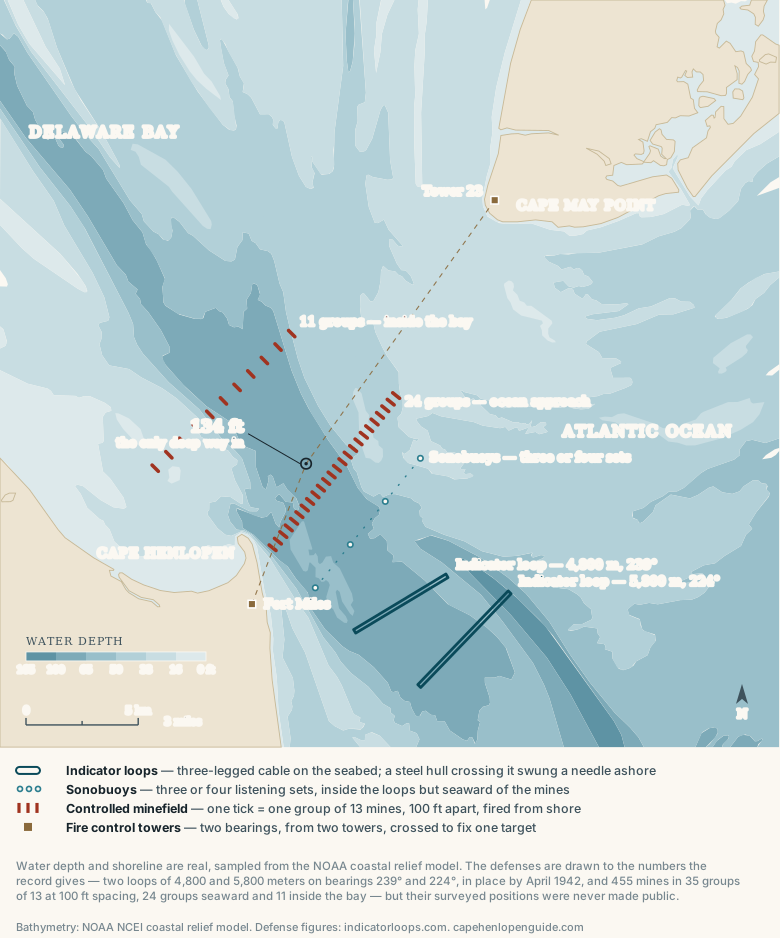
Furthest out, two cables. An indicator loop is a length of insulated wire lying on the seabed. Move a few thousand tons of steel over it and the hull’s own magnetism induces a current in the wire — enough to swing a needle on a galvanometer in a hut ashore. The Delaware loops were in place by April 1942: one 4,800 meters long on a bearing of 239°, one 5,800 meters on 224°. They stopped nothing. They told the watch officer that something steel had just crossed a line in the dark.
Inside the loops, the listening sets. Three or four sonobuoys, seaward of the mines and inside the wire, so a contact on the loop could be confirmed by ear before anyone reached for a switch.
Closest in, the mines. Four hundred and fifty-five of them, in thirty-five groups of thirteen, each mine a hundred feet from the next. Twenty-four groups lay on the ocean floor across the approach; eleven were inside the bay. These were controlled mines, not contact mines. They did not go off when a hull touched them. They sat on the bottom, wired back to a switchboard on shore, and waited for a man who had a loop trace, a sonobuoy contact and two crossed bearings from the towers to decide that the thing above them was not a friend.
Nearby
The watchtowers →
How two concrete towers, a telescope and a bell could pin a ship's position at sea.
The fishing pier →
The fort's old mine wharf, and the surrender that happened at the end of it.
The park →
Beaches on two coasts, the Great Dune, trails and camping.
Its twin is across the water
A battery of the same design as one of Fort Miles' own stands on the beach at Cape May Point, in New Jersey — and it stands on the open beach. Same drawings, same war, same bay. The Delaware one, Battery Herring, was stripped of its sand cover by the Navy and stands fenced off. The New Jersey one is being taken by the sea.